 Click on image to zoom.
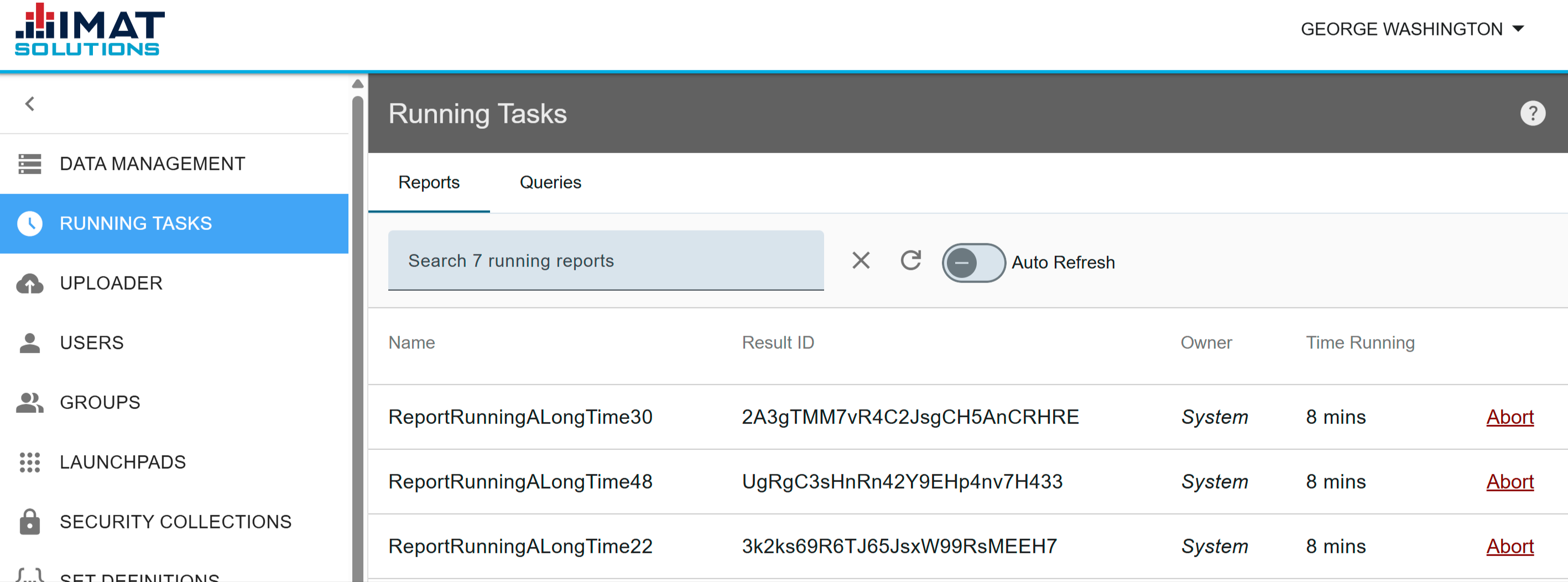
Running Tasks allows administrators to manage all currently running queries or reports. From this screen, they can view the owner, the ID, and the name. They can also abort any query or report.
 Click on image to zoom.
Review Report Details
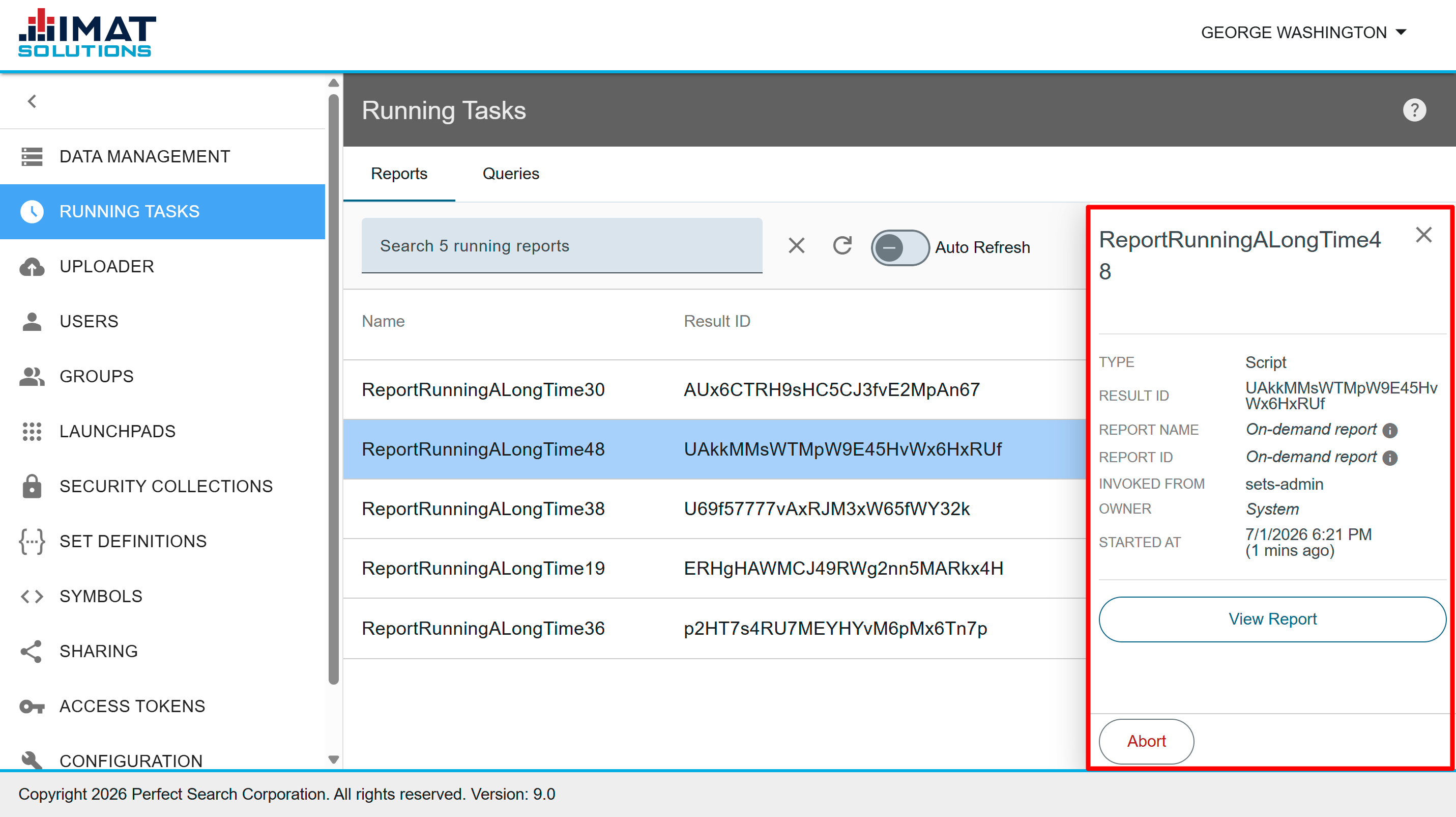
Verify you are on the Reports tab, and click a report to open the detail pane. The following report information can be found:
Type: This will either be a script or a plugin. A script report is a Python report. A plugin report is one of our specially built-in plugin reports (currently CCD or QRDA).
Result ID: A randomly generated ID used to assist in troubleshooting and retrieving report request artifacts (or output).
Report Name: The name of the report.
Report ID: A randomly generated ID used to record which saved report script is used for the request.
Invoked From: The location where the report was executed.
Owner: The username of the person who initiated the report.
Started At: The date and time the report was started.
Report names and IDs display On-demand report if the report was executed through Clinical Reports or reports using IMAT's API endpoints that include Python code. A name only appears if it is a VHR report, CCD report, QRDA report, or if you run a report using our endpoints directly while using the ID of a saved report.
You will need both the report ID and the result ID if requesting help from professional services.
 Click on image to zoom.
View Reports
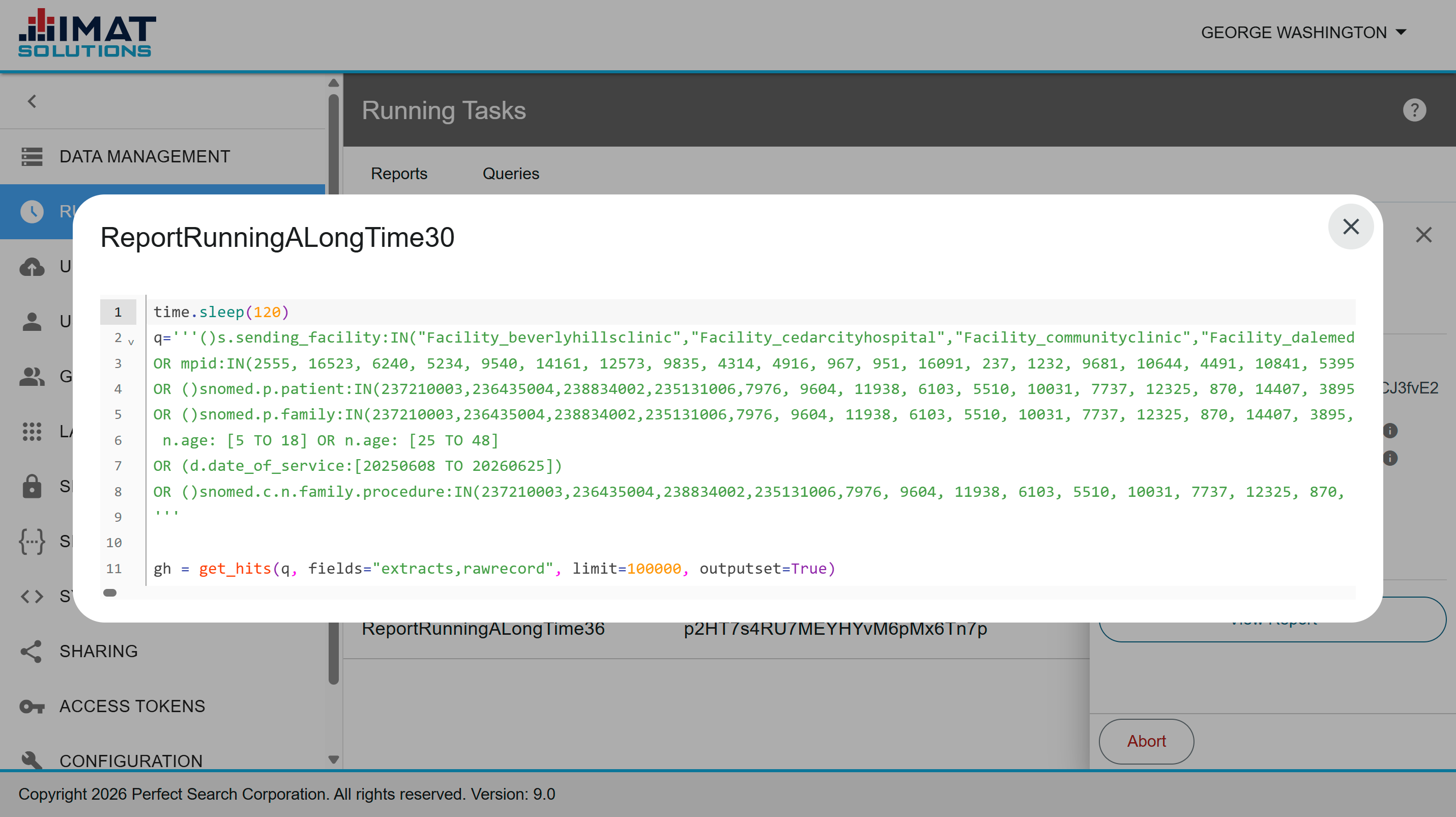
To view the report, click on any report and a details pane will open on the right. From there, click to view the full report. This is a good way to view others' long-running reports to check for errors in the scripts.
If you are running a plugin report such as CCD or QRDA, the button is unavailable.
 Click on image to zoom.
Abort Reports
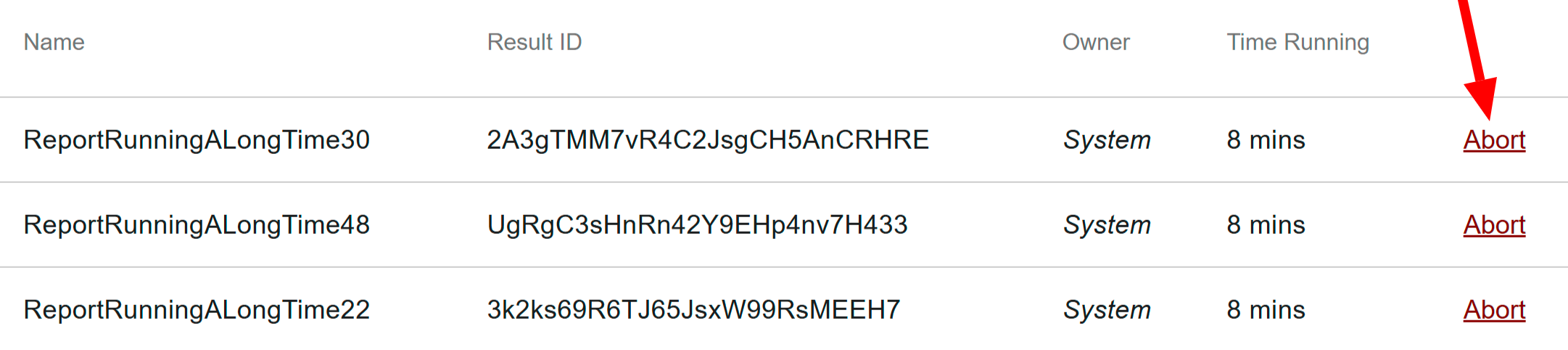
If you find that reports are running significantly longer than anticipated, you may abort a report for the user.
Be certain you want to abort the report because no confirmation dialog appears. You can abort a report in one of two ways:
Click Abort from the Running Reports home screen.
Click from the details pane that opens when clicking on a report.
 Click on image to zoom.
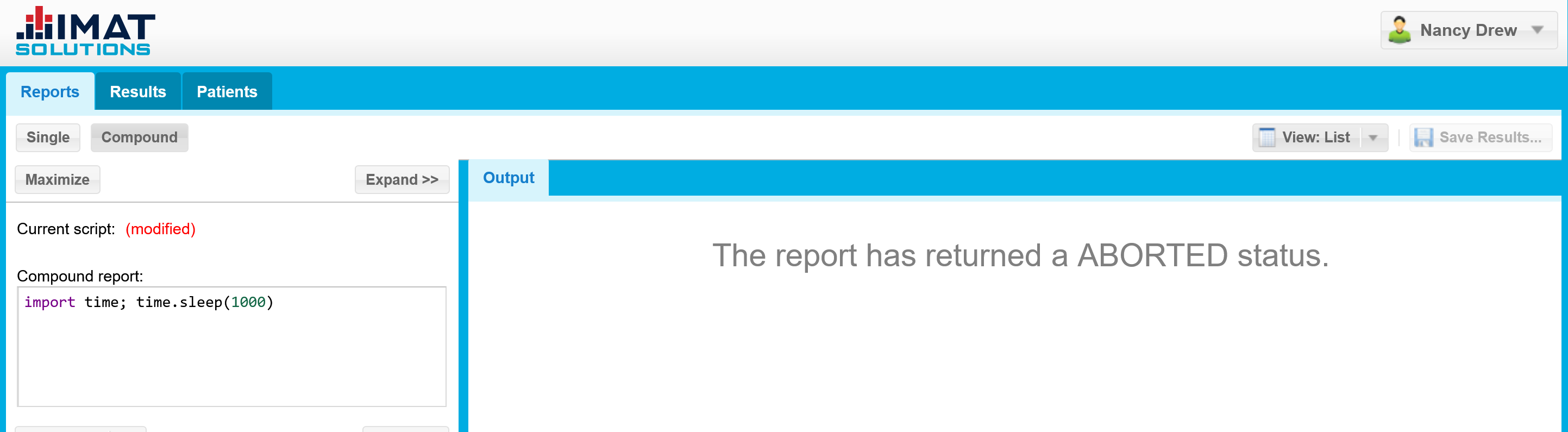
The person who executed the report will see a message saying that the report has been aborted.
 Click on image to zoom.
Queries
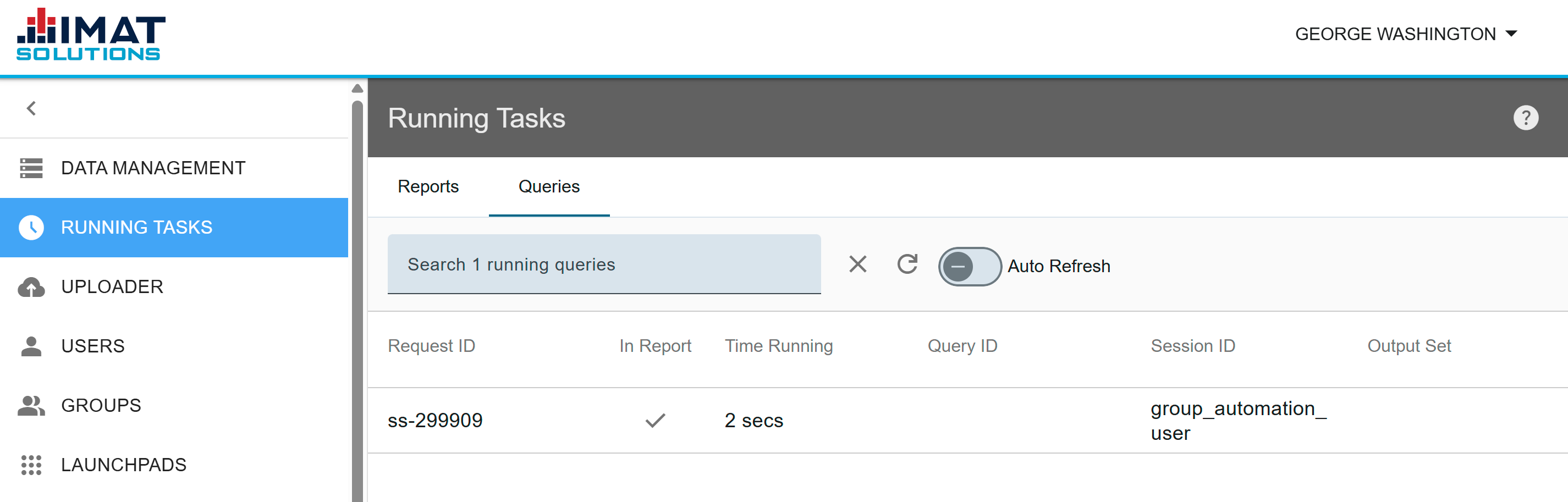
Whenever a user executes a query using any IMAT tool (Clinical Reports, VHR, Set Definitions, etc.), it appears on the Query tab. Most queries are fast-running and appear on this screen for a short time.
Note that if the report contains 1,000 lines, for example, and one of those lines contains a query, it appears on both screens. As soon as the query is complete, it is removed from the Queries tab but remains on the Reports tab until it is done executing. Similarly, if a report executes 10 queries simultaneously, all 10 will appear here until each is completed.
Here is some information on the columns:
Request ID: This may contain values that aren't real request IDs. Those are prefixed with "ss-" to differentiate them from a normal request ID.
In Report: A displays if the query is part of a report.
Query ID: A "set definition ID" column. A value is assigned if the query was a set definition.
Session ID: This appears only if it was explicitly given to SearchServer when executed (which happens with set definitions or admins forcing a specific session ID). If SearchServer had to ask the permission endpoint for the session ID, then that won't show up in this column.